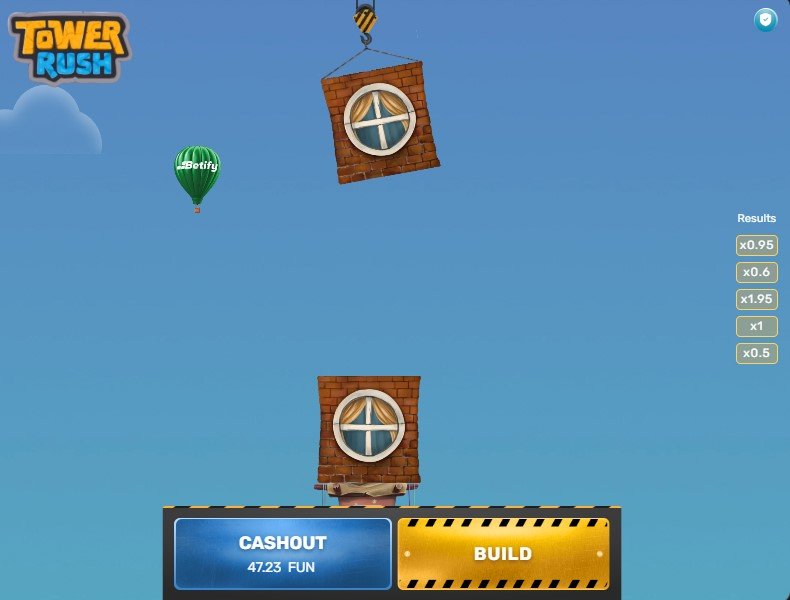
Essential Guide to Tower Rush
Winning at Tower Rush is not a formula. There is no secret code, hidden pattern, or trick that turns every session into profit. Those who promise otherwise are selling illusions.
What exists is a margin for maneuver. Tower Rush, unlike most crash games, incorporates a skill component into the gameplay. The player physically places each block, chooses the moment to cash out, and reacts to bonuses in real time. These decisions do not eliminate the house edge, but they influence the quality of the session.
This guide starts from an honest premise: no one beats the math in the long run. What can be done is to play smarter, structure sessions, avoid the most costly mistakes, and take advantage of favorable moments when they arise.
The game explained for those who really want to understand it
Most guides explain Tower Rush in three lines: "place blocks, the multiplier rises, cash out when you want." Correct, but insufficient for those who want to play seriously.
The block suspended by the crane does not move consistently. The amplitude of the swing varies from round to round and increases with the height of the tower. This means that the difficulty is not one hundred percent predictable. Two consecutive rounds can present different movement patterns at higher floors.
The alignment tolerance gradually decreases. At the lower floors, a slight deviation is accepted. On the tenth floor, the same deviation causes a collapse. The game does not explicitly communicate this reduction: the player perceives it through experience.
The multiplier follows a nonlinear curve. The lower floors are worth little (x1.1, x1.3, x1.5). From the sixth floor onward, growth accelerates. Interesting multipliers (x5, x8, x12) require surpassing the area where most players make mistakes.
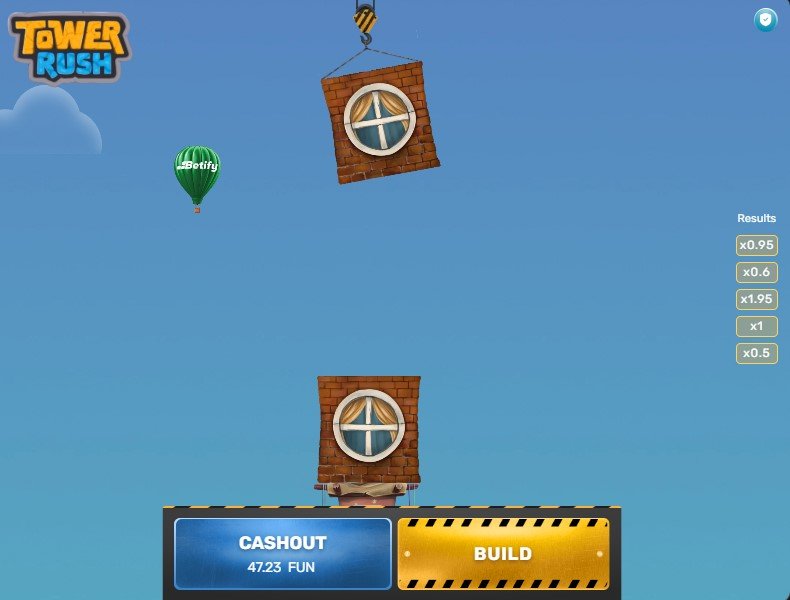
A detail that many overlook: the CASHOUT button and the BUILD button coexist on the screen throughout the round. The transition between building and cashing out happens with a single touch. There is no need to navigate a menu, no need to confirm. One click and the round ends. This immediacy is intentional: cashing out must be accessible the moment the player decides to exit.
The demo as a strategic tool
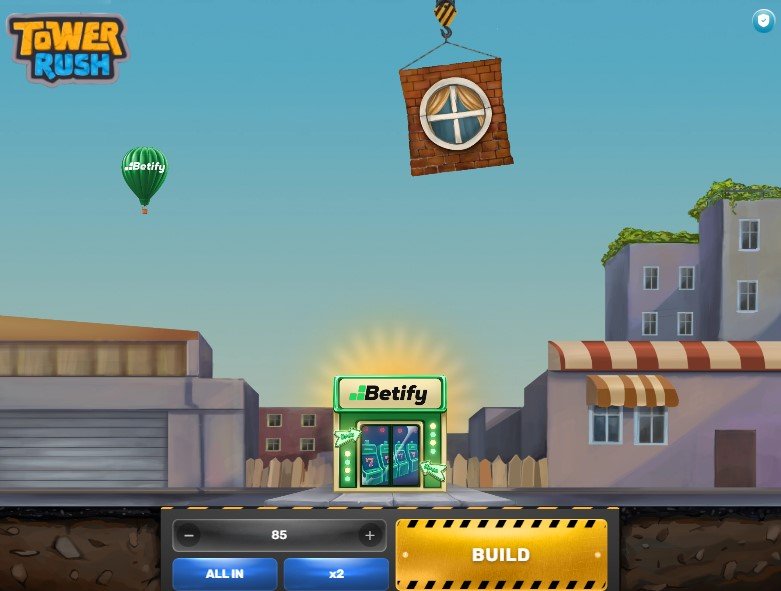
The most common way to use the demo: play for five minutes to understand how it works, then switch to real money. The smartest way: use it as a permanent training ground.
Suggested protocol for testing a new strategy:
- Define the strategy (e.g., fixed cashout at x6)
- Play 30 rounds in demo strictly applying the strategy
- Record the results: how many successful cashouts, how many premature exits, virtual net gain
- Repeat with a different strategy (e.g. mobile threshold x4-x8)
- Compare the results
After 60-90 rounds in demo spread over two or three approaches, the differences become visible. Not definitive (the variance on small samples remains high), but indicative of the type of session each strategy produces.
The demo does not replace real play. The emotional pressure of real money significantly changes behaviors. But starting with concrete data from the demo gives an advantage over those who improvise from the first paid round.
Concrete strategies: what works in practice
Cashout between x2 and x5. Regular wins with minimal risk.
Cashout between x6 and x10. Ideal balance between risk and reward.
Cashout above x12. Explosive wins but high risk.
The mobile threshold
Instead of setting a single multiplier for the entire session, a range is established. Example: cashout between x4 and x7. At lower levels, if the positioning seems fluid and the reflexes respond well, aim for x7. If concentration drops or placements become uncertain, exit at x4.
Advantage: adaptability. The threshold moves in real-time with the player's state. Limitation: requires good self-assessment skills during the game. Those who tend to overestimate their accuracy risk pushing too high.
The post-bonus protocol
Strategy based on reacting to bonuses rather than a fixed goal.
After aFrozen Floor: the gain is assured. Attempt 2-3 additional levels with reduced pressure. If the placement succeeds, the multiplier rises freely above the frozen threshold. If the tower collapses, the base gain remains.
After aTriple Build: three free levels have been added. The multiplier has risen without risk. The rational decision in most cases: cash out immediately. The bonus has already done its job.
After aTemple Floor: evaluate the result of the wheel. Significant bonus multiplier? Cash out to consolidate. Minimum multiplier? Continue normally, the Temple Floor hasn't changed much.
The closed budget session
Divide the total budget into three virtual envelopes. Example with €30:
- Envelope 1: €10, bet €0.50, target x4-x5 (warming up)
- Envelope 2: €10, bet €1, target x5-x7 (central phase)
- Envelope 3: €10, bet €1-2, target x6-x10 (ambitious phase, only if the previous two have produced positive results)
If Envelope 1 is completely exhausted, move to Envelope 2. If Envelope 2 also ends poorly, Envelope 3 is saved for another session. Do not touch it. Ever.
Advantage: protects the budget from the worst moments. Limitation: requires discipline not to open Envelope 3 when frustration pushes to "recover."
How the most experienced Italian players play
“Nick, Vicenza — March 2026** ⭐⭐⭐⭐⭐ (4.5/5) The mobile threshold is the method that has given me the most consistent results. When I feel clear-headed, I aim for x7. When I sense that the placements are not precise, I cash out at x4. It’s not science, it’s about listening to yourself.”
★★★★★
Beatrice, Ancona — February 2026** ⭐⭐⭐⭐ (4/5) My most costly mistake: not having a plan. I played the first sessions on instinct. The result was disastrous. Since I started using the three-envelope system, the sessions have become longer and less frustrating.
Stefano, Salerno — January 2026** ⭐⭐⭐⭐ (4/5) The Frozen Floor changes everything. Without that bonus, Tower Rush would be just another crash game. With the Frozen Floor, it becomes a game where calculated risk makes sense. When it activates, I always try three more levels.
Claudia, Pisa — March 2026** ⭐⭐⭐⭐⭐ (5/5) I have an Excel sheet where I record every session. Bet, multiplier reached, bonuses encountered, net result. After 200 recorded rounds, my decisions have become much more rational.
Emanuele, Sassari — February 2026** ⭐⭐⭐⭐ (4/5) I recommend everyone not to skip the demo. I still do 10 free rounds before every real money session. It helps calibrate reflexes, like a musician practicing scales before a concert.
Frequently Asked Questions
No. Tower Rush uses a certified RNG and the casino maintains a mathematical edge. Strategies are meant to structure sessions, not to eliminate risk.
Its appearance is random, managed by the RNG. It can activate in the fifth round or not appear for an entire session. No predictable regularity.
For a beginner in crash games: at least 3-5 sessions of 15-20 minutes. For those with experience: 10-20 rounds to familiarize with the specific mechanics of Tower Rush.
The minimum bet (€0.10) during the first real money rounds. Gradually increase only after finding your emotional balance with real money play.
No. With a round closure rate of about one-third, sequences of 4-5 rounds without cashout are common. Doubling the bet after each closure leads to a rapid escalation that burns through the budget.
Up to level 8-9, the experience is comparable. Beyond that, the PC offers an advantage in cursor precision compared to thumb touch.
Our rating — 4.2/5
Tower Rush offers more room for player decisions compared to almost all crash games. Manual positioning, free cashout, reacting to bonuses: each round contains choices that influence the outcome. They don't determine everything, but they matter.
The strategies presented in this guide do not promise profits. They offer a framework. A way to approach sessions with clarity rather than impulse. The mobile threshold, the post-bonus protocol, the closed-budget session: practical tools that adapt to different profiles.
The game deserves its reputation in the crash game segment. The RTP is competitive, the bonuses are well-designed, and the active gameplay sets it apart from passive competitors. However, variance remains high and the casino's edge is real. Playing for fun, with a budget that doesn't weigh heavily, remains the golden rule.
Rating: 4.2 / 5⭐⭐⭐⭐
Skill versus luck: where is the line drawn
Tower Rush occupies an unusual position among casino games. It is not pure luck like slots. It is not pure skill like poker. It lies in an intermediate zone where both components weigh in.
The skill component comes into play with block positioning. A player with trained reflexes and good hand-eye coordination survives longer in rounds, accessing higher multipliers. Practice measurably improves results. Someone who has been playing for a month positions blocks more confidently than someone who has been playing for a day.
The luck component affects the amplitude of fluctuations, the frequency of bonuses, and the behavior of the RNG that determines the specific difficulty of each round. A perfectly trained player can still fail a positioning if the fluctuation pattern is particularly unfavorable.
The relationship between the two components changes with height. At lower levels (1-5), skill matters little because the tolerance is wide and almost everyone can position correctly. At higher levels (10+), skill becomes crucial but not sufficient. The variance of movement makes guaranteed precision impossible.
Practical consequence: improving one's skill extends sessions and increases the survival rate per round. But it does not eliminate variance. Sequences of rounds ending prematurely also happen to the most experienced players. Accepting this avoids frustration and impulsive decisions.
The most costly mistakes
Five behaviors that separate disastrous sessions from manageable ones.
Chasing the previous round.The tower collapsed at x11, just a moment before the cashout. The next round, the bet is increased to compensate. Bad idea. Each round is independent. The RNG does not remember what happened before.
Playing without a plan.Open Tower Rush, deposit, start clicking. No cashout goal, no budget limit, no session duration. The recipe for losing control in fifteen minutes.
Ignoring fatigue.Tower Rush requires constant concentration. After 25-30 minutes, reflexes slow down imperceptibly. The placements that were precise in the early rounds become approximate. The player doesn't notice because the decline is gradual. The results, however, do reflect it.
Confusing luck and skill.Five consecutive rounds with cashout at x8+? Feeling invincible. "I'm on a roll tonight." No. The RNG has produced favorable conditions. The next round is completely independent. The winning streak predicts nothing.
Betting too much relative to the balance.Putting 10% of the balance on a single round when volatility is high means that three consecutive closures represent 30% of the budget. At that point, the session is compromised. The 2-5% rule exists for a reason.
The budget as the foundation of everything else.
Without budget management, no strategy holds. The budget is the prerequisite. Not a detail.
Practical formula for a session:
| Balance | Recommended bet (3%) | Estimated rounds |
|---|---|---|
| 15€ | €0.45 → round to €0.50 | 20-30 |
| 30€ | €0.90 → round to €1 | 20-35 |
| 50€ | 1,50€ | 25-40 |
| 100€ | 3€ | 25-45 |
A principle that regular players often repeat: the gaming budget must come from money that one is willing to spend entirely for fun. Not from savings, not from amounts intended for daily expenses, not from loans.
The boundary that should not be crossed.
Winning at Tower Rush is possible in single sessions.
Winning at Tower Rush consistently and predictably is not. The casino maintains a mathematical edge of 3-4% that, over the long term, always works in its favor.
Playing to win is fine.
Playing out of a need to win is not. The difference may seem subtle, but the consequences are profoundly different.
3.
Signs indicating a problematic relationship with gaming:
4.
Playing with money intended for other needs, feeling the need to recover lost amounts, lying to others about the frequency or amounts played, experiencing anxiety or irritability when unable to play, progressively increasing bets to achieve the same thrill.
Gambling Helpline: 800 558 822
Free, anonymous, non-judgmental.